by Farmer Melanie | Farm Life Blog
Cow Agenda
 You think you get the cow agenda and then you don’t. This post is a little peak into some of the great insight we have into the lives of animals. It is so enjoyable to get to know the various species that we have. The cows are peaceful and placid and stand around and eat a lot. They really, really like routine and really, really detest change. That produces a stubborn streak that rears its head just when you are least prepared to receive it. This happens particularly when you have in mind the other tasks of the day that await your attention. In other words, your attention is in the future and not in the present moment. Frustration ensues because, at that point, the cow agenda becomes one of suddenly losing all sense of what they do every day at 9:00 in the morning.
 Cows are, as many other ruminants, creatures of habit. Once you have them trained to a particular path or “agenda” they will pretty much follow it without too much effort on the part of the farmer. This holds true until you, the farmer, have another agenda. Being efficient in nature, you are already there in your mind taking care of business. You expect the cows to follow along with your plan. In reality, cows will follow your thoughts pretty well. Or perhaps it is body language and other communication cues that make up the other 93% of communication that humans provide that is not speech. Who knows. What I do know is that if I am not fully present with them, things begin to get a little dicey and do not go according to my human plan. The cow agenda, which is not mine and completely unknown to me at this point, takes over. I believe they must chuckle or signal to each other, “Silly human!” Once mindfulness returns, cow orderliness returns. It’s pretty simple really.
 It goes like this. The cows walk up to the milking parlor everyday. The two milkers automatically go into the milking area and the rest pass by and go to an adjacent area where they get fresh hay and perhaps a small treat. On the day in question, one milker goes into the milking parlor, the other goes on around with the other cows. We have to chase her back. Then she wants to play tag or perhaps hide-and-seek or maybe catch-me-if-you-can. Following that, she decides to manifest her mule personality. Now she refuses to move at all. Sighhhh.
It is at this point I realize I am not fully present. I’m on to the next task. I am getting really frustrated. So I stop, take a deep breath, focus on the present moment and give the cow my full attention. I look at her. She looks at me. I stand back and give her room to move forward. She moves forward, giving me a larger girth than usual, and proceeds to enter the milking parlor and puts her head into the stanchion. That’s all it took.
Cows are creatures of habit. Anything different can upset them. Even if it is a simple change in the farmer’s demeanor and attention. Farming is a learning experience every day. It’s learning about the animals and it’s about learning about me.
May peace be with you always.

by Farmer Melanie | Farm Life Blog
The Garden and the Creamery
 One of the first things that Scott did when we “retired” to the farm was build me this really fantastic garden. It is made of cinder blocks. You can read more about it here. He created it to be a permanent structure, requiring as little maintenance as possible. There is still a bit of work to do to make the soil the best garden ever, but we were able to plant lots of vegetables and they are growing.
Due to the length of time it took to build my really great garden, we started too late to have early peas, lettuce and broccoli. There was lots of time to plant the rest of the garden. I planted two types of corn, perhaps five different bean species and no less than five different squash varieties. The watermelon and sweet potatoes are vining all over the place. The tomatoes are large enough to be staked up off the soil with lots of green ones growing at a rapid pace. I have a few beets, chard, turnips, kohlrabi and rutabagas coming along nicely. One eggplant has a couple of fruits and the peppers are just getting started.
Yesterday we went out together to pick off any squash bugs that might be around, and we were also looking for vegetables to harvest. So far this year I have picked a couple of meals worth of yellow wax beans, a few green beans and one patty pan squash. Oh, and a radish or two.
The best part of gardening is getting to pick the vegetables. As you can see from the picture, I now have black-eyed peas, potatoes, purple podded pole beans in addition to the aforementioned wax and green beans. Yum, Yum.
Breaking Ground for the Creamery
 Scott rented a little machine that I call a Bobcat. He has another name for it (track loader). This little gem he used to dig out the high ground and move it to the low ground. The purpose was to shape the building foundation area. The way he did it meant we did not need to truck in any other fill dirt. That saved a lot right there.
One end is 28″ higher than the other. That is to facilitate the milking area. While it is higher than the rest of the building, it is at ground level where the cows will enter and exit the building. Scott is an absolute genius at using the lay of the land to harmonize his plans with the original plan of the creator.
We have scheduled visits from the propane gas and electric companies for next week. They will be providing the much needed input to move forward with power and hot water for the creamery. And as soon as the ground dries out enough, Scott has a machine rented to help with digging the footers for the foundation walls.
We are moving right along with this project. It is truly an exciting time at the farm.
by Farmer Melanie | Farm Life Blog
Peaceful Heart Cheese

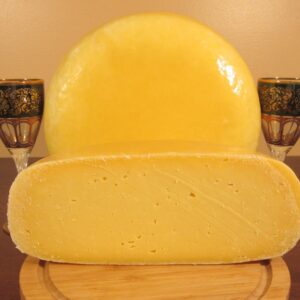
We made cheese again on Monday. This time we made ‘Peaceful Heart’. It is a semi-soft, washed curd cheese which makes it deliciously mild and creamy.
We will age it for around three months. The interior of the cheese has tiny holes throughout the paste. It demonstrates a creamy to yellow color. The cheese will be mild to sharp in flavor and buttery depending on how long it is aged.
We will list it on this site for taste testing in about three months so mark you calendars now if you want to have some for your Thanksgiving dinner.
More Farm Exercise
 This afternoon it was time to move the animals to a new piece of pasture. As you may know, we rotationally graze our animals. That means we let them graze in one place for a few days and then move them to another. This keeps the grass from being overgrazed and our pastures in tip-top shape. It also keeps the parasite population down. There is no host and by the time the animals return to any given section of pasture, the parasites have died off.
The cows and sheep were close by where we needed to move them. The goats, however, were nearly as far back in the woods as they could get (think a quarter mile walk). Moving them out of the woods was a hazardous adventure for me due to lots of trees and old limbs on the ground. I carefully picked my way through the debris, got the goats out into the main pasture (with Scott’s help) and made my way back to more solid ground with only one slight slip and no falls.

Once they were in the open, we gently herded them to the next pasture for fresh grass. Since January we have been working to tame them. The whole lot of them were wild and very hard to manage. But with persistence and lots of treats, we have successfully brought them to the point that we can now walk within 4 or 5 feet of them. They simply trot along ahead of us, looking over their shoulder once in a while as if to seek escape if we are not paying attention.
All animals are happily munching on new grass at this moment.
Milking the Cows
 We are not sure what is going on with Buttercup. For the past two days she has been reluctant to put her head through the milking stantion where she is gently held. Her daily treat is waiting there yet she is very wary. Today Scott had to get a rope around her neck and give her a long slow tug to get her to put her head through that same opening she has stood in for months.
We put a halter on her just in case she is still acting shy tomorrow. Gentleness and patience is what works for milk cows. Buttercup is an exercise in patience. She was really cute when she was young as you can see in this pic. Claire is the bigger one. Claire has no trouble going in her stanchion; I have to encourage her to leave!
That’s about it for this update. Leave your comments below or go to our Contacts page for questions and comments on other topics.
by Farmer Melanie | Farm Life Blog
Animal Husbandry and Farm Exercise
In this post I want to give an update on our animal husbandry tasks and expound on how much exercise is a daily part of farm life. Over the past couple of weeks we have trimmed hooves on most of our small goat herd and sheep flock plus the donkeys. We are still waiting on the anticipated birth of a new mini-donkey. And we made a trip to Meadowcreek Dairy in Galax, Virginia to check out their operation.
Farm Exercise

Let’s start with exercise. One of the main reasons we have for starting our farm business is to do creative things and keep fit into our twilight years. Many people retire then get almost no exercise. Others have the freedom in retirement to spend lots of time at the gym. By far, the ones frequenting the gym live longer with more productive and active lives. But the gym has no appeal for us. We like the outdoors and love nature. Just watching nature do its thing is a joy for us. Getting our daily exercise is completely integrated into our lifestyle. There is no need to cut out a part of our day to go somewhere else.
I know a lot of you may have a goal of walking 10,000 steps per day. That’s a lot of steps and likely difficult to manage in a normal day without just going to the gym and walking on the treadmill. I could never manage it. Boring! 😯 Here’s how the day goes for me. Just this morning my tasks included feeding the bottle lamb, milking the cows and moving the main herds to another field. I walked nearly 5,000 steps. Yes, that’s right. Just the morning chores got me halfway to the goal. And it was a joy!

Our farm is in the foothills of the Blue Ridge Mountains. No matter where you go, it really is uphill both ways. Yes, yes, there is some downhill in between. But still, those hills are the bomb for getting that heart rate up. The birds are singing. Often a light breeze is blowing. This morning was cooler than previous mornings so that was good too. Life is good.
There are days when the heat is oppressive. I sweat a lot. In addition to other benefits, sweating is really, really good for my skin. The milking and other chores get done in the morning no matter the temperature. But in the afternoon I can work inside on stuff like this blog, the finances or some other marketing task until later in the afternoon when it begins to cool down. That’s when I will go out into the garden, pull a few weeds and generally enjoying the fruits of our labor. Scott rarely does that. Usually, he is out there sweating continually doing some task or another.
And that brings me to the next topic.
Goat the Sheep Hoof Trimming

A big part of animal husbandry on our farm is keeping those hooves in good shape. Donkeys, sheep and goats all need that treatment. Last week a task popped up on my calendar that it was time to check the goats and sheep for general health and trim their hooves. We still need to get to the boys later this week. Two rams and 8 bucks. The girls and their young were done a few days ago.

We currently have 15 goat and 9 sheep in the main ‘girls’ herd/flock. Starting at around noon on a hot summer day, we began the task. Scott manhandled each animal and I wielded the hoof pruners. Scott catches them and then turns them upside down into a “chair” that is specifically made for this purpose. Once a goat or sheep is on their back kind of sitting with feet up, they stop resisting. They don’t resist as much anyway. They can, and the young goats do, make lots of noise but they can’t really get out of the “chair” until Scott turns them right side up again, out of the chair.
We finished at 6:00 pm. There is nothing for it but to work straight through with only short breaks to drink some water or Gatorade. Yes, six hours straight to get done. The task entails digging out manure from the hooves prior to trimming the excess material. I smelled that long into the night. Should have used the neti pot on my nasal passages during my shower. Well, live and learn.
Donkey Pregnancy

We are still anxiously awaiting the arrival of Sweet Pea’s offspring. No ultrasound to tell us whether boy or girl. We will be surprised and accept whatever creation brings to us. Young animals being born are always eagerly anticipated on our farm.
This will be Sweet Pea’s last foal. Daisy and Cocoa will also continue their lives without additional foals. We made the decision to keep this small herd of donkeys and no more. Our land can support a limited number of animals and each needs to have a purpose supporting the whole. The purpose of the donkeys is protection for the lambs. They have been doing a really great job and we expect that to continue. Daisy is about 10 years old now and Sweet Pea is 7. We expected to have them as our companions for years to come. Donkeys live a long time. They will both likely be with us for another 30 to 35 years.❤ ❤ ❤
Visiting Other Farms

The last thing I want to mention is our trip to Meadowcreek Dairy. They are a little less than an hour’s drive from us. The business operates near Galax, Virginia in Grayson county. They have a new piece of farm land that buts up against the Blue Ridge Parkway. It was gorgeous up there. They make cheese at an elevation of 2800+ feet.
As we get ready to lay the foundation for our creamery, visiting other farms has been part of our preparation. Scott wanted to see how others set up their barns. How does the animal flow work? What kind of equipment do they use? What are the advantages and disadvantages that each farmer found with their choices? We have visited about a half dozen farms and each one is different in how they set up their milking operation.
The great people at Meadowcreek Dairy spent more than a 1/2 day with us, showing us the cheese make room through a window and two different milking parlor setups. They have traveled to Europe and New Zealand, performing a similar action to ours on a world wide scale. They wanted to see how milking and cheese making is done in those areas of the world. Their milking parlor reflects those cultures.

There are two sides to the cow milking parlor. Rather than running the milkers on both sides at the same time, they do one side and then the other. With two people that allows one person to be prepping the cows on one side for milking while the other person is actually setting up and monitoring the “claws” on the other side. Then those cows are let out, then next group of cows comes in and the farmers switch sides while walking along the pit. The one setting up and monitoring the milking machine moves to the freshly prepped cows, while the one prepping moves over to prep the new set of cows that just entered the parlor. Or they can simply work in tandem. Lots of choices.

The barns are open and tall, with lots of air flowing through. This was the part that I really liked. Closed milking barns can be very, very hot in the summer. Also, the cows are much happier if they don’t have to go into a hot, dark place. They are much more willing to just walk into the open-air space, stand while being milking, and then parade back out into the field to continue their daily joy of eating lots of grass.
The folks at Meadowcreek were very generous with their time and information. We look forward to the time when we can do the same for the next small farmer looking to create a hand-made, farmstead or artisan cheese operation.
That’s it for now. Long days and pleasant nights.
by Farmer Melanie | Farm Life Blog
Picking Blackberries

BEFORE clearing rows, wild berry forest,
There is nothing more satisfying than harvesting your own food, especially when it comes to picking blackberries. Or blueberries for that matter. Or tomatoes and potatoes. Anyway, this evening it was picking blackberries. I have about three gallons in the kitchen sink right now. I will wash and store them in a bit.

AFTER clearing rows, from ‘travel lane’
We didn’t get many blueberries, even though there were hundreds and hundreds and hundreds of berries on the bushes. The local raccoons are getting pretty fat because we are feeding them. Keeping the local varmints out of the berries is a project for next year. This year we are just glad to have been able to dig the bushes out from a couple years neglect. They were riddled with wild blackberries and every other kind of weed imaginable, plus young trees.
We have had a very busy couple of weeks. Yesterday we made cheese. Havarti was the chosen delight for this week. The day before we drove 5 hours to borrow a young Normande bull that we had sold last year. Then drove 5 hours back. Tomorrow’s project is trimming donkey hooves along with milking and such. The following day will see the goats and sheep get inspected and their hooves trimmed as needed.
Visiting Other Farms
Let me take these events one-by-one and fill in some details. I left out one big event and I will start with that one. Two days ago we visited a local farmer and checked out his operation. We wanted to take a look at his milking parlor. He also had a cheese making setup we wanted to see. He made a very different kind of cheese. He used a combination cheese vat and pasteurizer. He was making fresh cheese, therefore the milk had to be pasteurized before processing. Pasteurizing ruins the flavor but there is no getting around the government regulations about fresh cheese.
He also had several other ideas in the works on his farm. He has 50 white ducks and is now selling duck eggs. He also had some meat goats. We had a nice chat about that business. It is fun to go out and visit others in the area to learn the ‘what and how’ they are doing. Everyone has a different vision and creative ways of using their land.

So that was two days ago. The next day we took that long trip to pick up the bull. We want to use artificial insemination at some point soon, but we just have too many other things going on right now. To learn one more thing would be just too much at this time. That dairy farmer was very practiced at AI so could serve as a tutor on this at a later time. So Scott came up with the brilliant idea to use the young bull that we sold last year. After a few Facebook messages were exchanged, we set up the details to borrow him. As long as we pick him up and drive him back, we were good for go for a 2 1/2 months breeding period. We expect him to be able to take care of all that needs doing in that amount of time.
It was as very long day. It actually took us about 6 1/2 hours to get there due to an unplanned excursion northward instead of due east. But we got back on track and made the return trip with no issues. We also were able to visit that other farm and check out their various operations. As I said, it’s great fun for us. This farm has some really great Jersey cows. They also have ducks, chickens, peacocks, alpacas, pigs and sheep and probably something else I’m leaving out (oh yeah, friendly dogs and kids). They are very diversified. We will have much the same at some point in the very near future by adding chickens and pigs (maybe ducks also). At least I hope so. 😛
Making Cheese

Yesterday was cheese making day. We made Havarti from 18 gallons of our cows’ milk. It was Scott’s first time with this cheese in over a year. He did a fabulous job. You know when you first start making cheese it can be a very daunting task. There is just so much to know. But after you get the basics down, trying out a ‘new’ cheese is simply a variation of the skills you’ve already built plus following the recipe that is in front of you. We expect that in 3 months or so we are going to have some really good cheese from this batch.
Our two cheese refrigerators are filling up fast. Check out our store here to contribute to the creamery. You can get a cheese sample.
Animal Husbandry

Tomorrow is donkey hoof trimming day. Every four months a task pops up on my calendar to take care of their feet. We have four donkeys. Each one is a little different in their response to this treatment. Daisy and Sweet Pea are the easiest to work with, though it was not always that way (nervous). Johnny Rebel, the jack, usually fights the process, but we always win. And the littlest girl, Cocoa, is a handful. She is the youngest and most skittish when it comes to human contact. The others love the touching, talking and brushing: Cocoa sees this happening right next to her yet is not convinced that we should be touching her at all.

Then come the hoof trimming for the goats and sheep day after tomorrow. They also need to have their hooves trimmed and we will also check for signs of anemia, worms or other issues.

These are long days that require a lot of strength and patience from Scott. He is literally required to manhandle the goats and sheep. The goats don’t weigh as much as the sheep, but there are more of them.
That is just covering 5 days of activities. I love each day here.
There is always something that needs doing. Even if it if just making ice cream. I have strawberries, peaches and blackberries in the frig.
Yum, yum.